5 Reasons Avail (AVAIL) is the Future of Modular Crypto
Learn how Avail (AVAIL) is transforming Web3 with modular data availability. From Polygon origins to 2026 breakthroughs, here is your ultimate guide.
By Yaser | Published on March 1, 2026
Introduction to Avail and the Modular Revolution
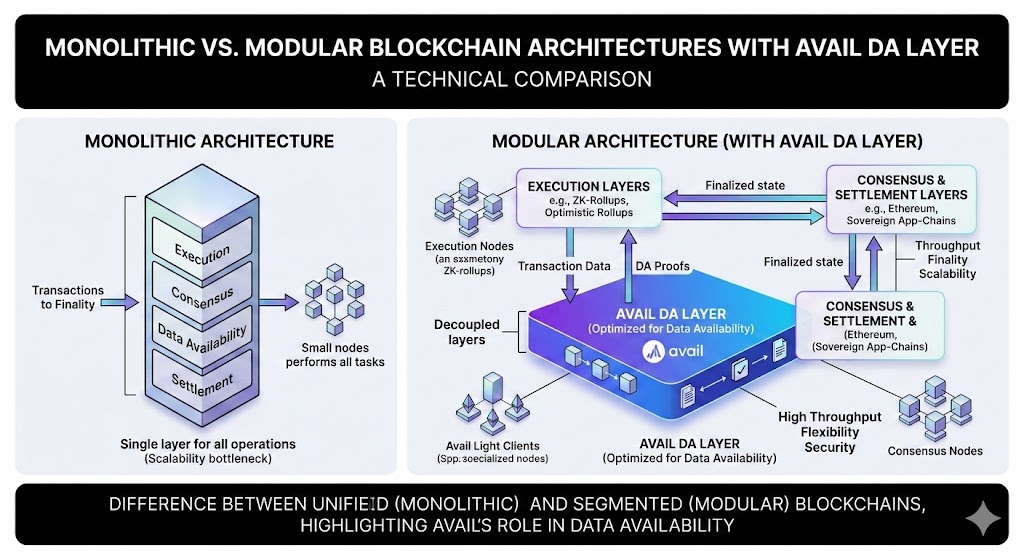
The landscape of blockchain technology is undergoing a massive shift from monolithic designs to a more efficient modular approach. For a long time, networks like Ethereum handled everything—from execution to data storage—on a single layer, which often led to high fees and slow speeds. However, Avail (AVAIL) has emerged as a specialized solution designed to fix these bottlenecks once and for all. By focusing specifically on data availability, Avail allows developers to build scalable, secure, and interoperable applications without the heavy burden of traditional blockchain constraints.
The Problem with Monolithic Chains
Traditional blockchains are often referred to as “monolithic” because they perform every task in one place. While this was fine in the early days of Bitcoin, modern demands have proven that this model is simply not sustainable for global adoption. Consequently, users often face astronomical gas fees and frustrating transaction delays during times of high network congestion. Modular blockchains solve this by breaking these tasks into separate layers, which significantly improves overall efficiency and reduces the cost of maintaining the network for everyone involved.
What Makes Avail Different?
Avail stands out because it is not trying to be a “do-it-all” blockchain; instead, it focuses on being the best at one specific thing: providing a robust data availability layer. This specialized focus means that other blockchains and rollups can “offload” their data needs to Avail, ensuring that information is always accessible and verifiable. Furthermore, by utilizing cutting-edge mathematical proofs, Avail ensures that even small devices can verify data without needing to download the entire chain, making it more decentralized than many of its competitors.
Why Modular is the 2026 Trend
As we move through 2026, the modular narrative has become the dominant force in the crypto market. Investors and developers alike are realizing that the “one-size-fits-all” approach is over. Avail is at the heart of this movement, providing the essential infrastructure that powers thousands of new decentralized applications. Consequently, understanding how Avail functions is no longer just for tech enthusiasts; it is a fundamental requirement for anyone looking to navigate the modern digital asset economy successfully.
The Origin Story: From Polygon to Independence
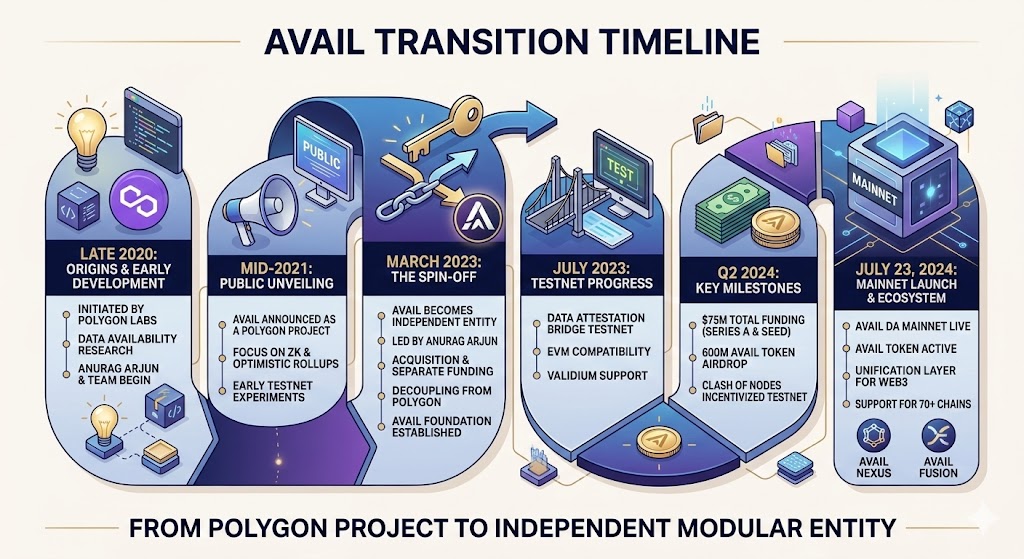
Every great project has a compelling history, and Avail is certainly no exception. The project actually began its life inside the halls of Polygon, one of the most successful scaling solutions for Ethereum. It was originally known as “Polygon Avail,” led by co-founder Anurag Arjun. However, the team soon realized that to truly revolutionize the entire Web3 space, Avail needed to be an independent, neutral entity that could serve all blockchains, not just those within the Polygon ecosystem.
The Vision of Anurag Arjun
Anurag Arjun is a well-known figure in the crypto world, having played a pivotal role in the early success of Polygon. His vision for Avail was born out of the necessity to solve the scaling trilemma—balancing security, scalability, and decentralization. He recognized that while execution layers were evolving quickly, the underlying data layer was still a major weak point. Therefore, he decided to spin Avail off into its own standalone project to ensure it could provide unbiased, high-performance services to the entire industry.
The Strategic Move to Independence
In early 2023, Avail officially separated from Polygon to become its own sovereign network. This move was a strategic masterstroke because it allowed Avail to partner with various ecosystems, including Ethereum, Solana, and Cosmos, without being tied to a single competitor’s interests. As a result of this independence, Avail was able to secure significant funding from top-tier venture capitalists who saw the potential for a universal data availability layer. This transition marked the beginning of a new era for the project and its growing community.
Building the Foundation for 2026
Since its departure from Polygon, the team has worked tirelessly to build a mainnet that is both resilient and future-proof. They spent years in development and testing to ensure that the architecture could handle the massive data loads expected in 2026. By focusing on a long-term roadmap rather than short-term hype, Avail has built a reputation for technical excellence. Consequently, it is now viewed as a cornerstone of the modular stack, proving that its early decision to go independent was the right move for the long term.
Understanding the "Avail Trinity": DA, Nexus, and Fusion
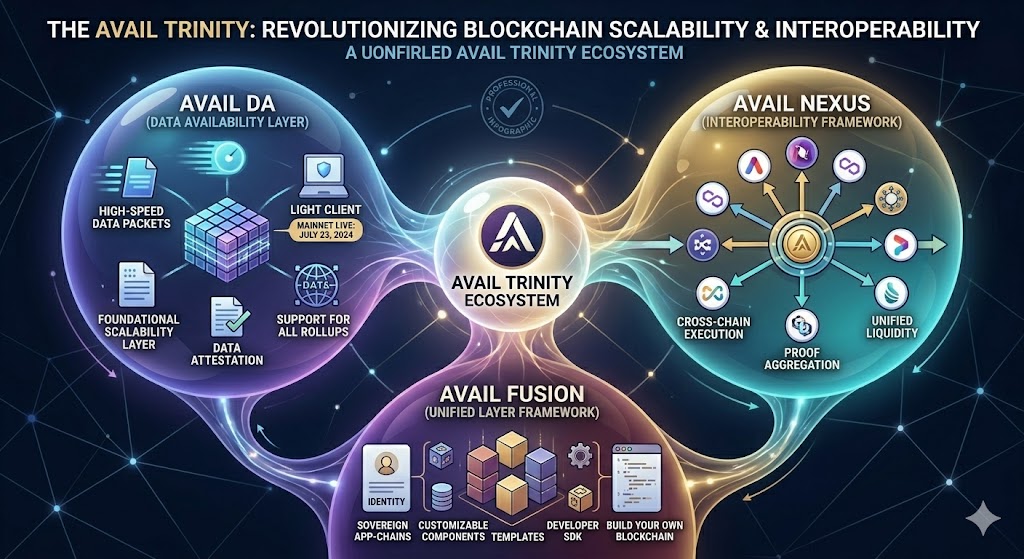
Avail is much more than just a storage layer; it is a comprehensive ecosystem often referred to as the “Avail Trinity.” This three-part architecture consists of Avail DA, Avail Nexus, and Avail Fusion. Together, these components create a unified experience for developers and users, solving the fragmentation problems that have plagued the modular space for years. By integrating these three pillars, Avail offers a complete solution that goes far beyond what simple data storage providers can offer.
Avail DA: The Core Engine
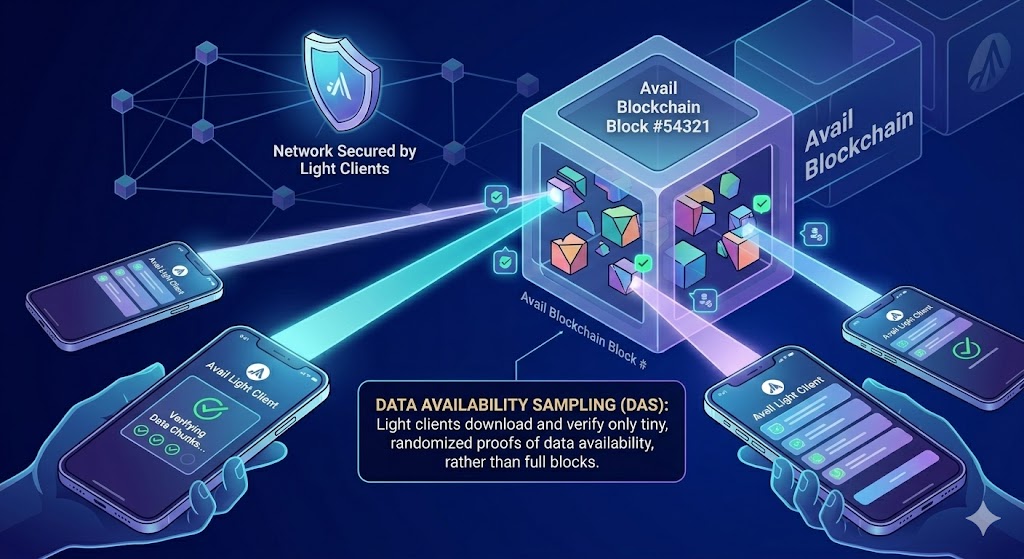
The first pillar is Avail DA, which stands for Data Availability. This is the foundation of the entire system, utilizing “Data Availability Sampling” (DAS) to allow light clients to verify data instantly. In simple terms, it ensures that all the transaction data needed to reconstruct a blockchain’s state is publicly available. Moreover, because it uses mathematical “KZG commitments,” it provides a much faster and more secure way to prove data existence than older methods, making it the fastest DA layer on the market today.
Avail Nexus: The Unification Layer
The second pillar, Avail Nexus, acts as a coordination hub for all the different rollups and blockchains built on top of Avail. One of the biggest issues in crypto today is fragmentation—assets are often stuck on different chains that cannot talk to each other. Avail Nexus solves this by providing a standardized messaging layer that allows for seamless cross-chain transactions. Consequently, a user on one rollup can easily interact with an application on another rollup, creating a truly “unified” Web3 experience for the end user.
Avail Fusion: Shared Security
The third and final pillar is Avail Fusion, which focuses on providing “Shared Security” for the entire ecosystem. It allows Avail to use assets from other major blockchains, like Bitcoin or Ethereum, to help secure the Avail network through a process called “re-staking.” This is revolutionary because it means that Avail doesn’t have to rely solely on its own token for security. In addition, this creates a stronger, more resilient network that is much harder for malicious actors to attack, providing peace of mind for institutional investors.
Why Data Availability (DA) is the Holy Grail of Scaling
To understand why Avail is so important, you must first understand the “Data Availability Problem.” In any blockchain, nodes need to know that all the data for a new block was actually published to the network. If a block producer hides some data, they could potentially steal funds or freeze the chain. Therefore, ensuring data availability is the most critical part of scaling. Avail provides a specialized, low-cost environment where this data can be stored securely and verified by anyone in seconds.
Solving the Rollup Bottleneck
Rollups are the most popular way to scale Ethereum, but they face a major problem: they still have to post their data back to the main Ethereum chain. Unfortunately, Ethereum’s mainnet space is extremely expensive, which keeps rollup fees higher than they should be. By using Avail instead of Ethereum for data storage, rollups can reduce their costs by over 90%. As a result, users can enjoy sub-cent transaction fees while still benefiting from the high security that the modular architecture provides.
Light Clients and Decentralization
One of Avail’s most impressive features is its support for “Light Clients.” Typically, to verify a blockchain, you need to run a “Full Node,” which requires expensive hardware and lots of storage. However, Avail’s light clients can run on a simple smartphone or even a web browser. They use Data Availability Sampling to verify that data is present without downloading the whole block. This promotes massive decentralization because thousands of people can help secure the network using basic devices they already own.
The Role of KZG Commitments
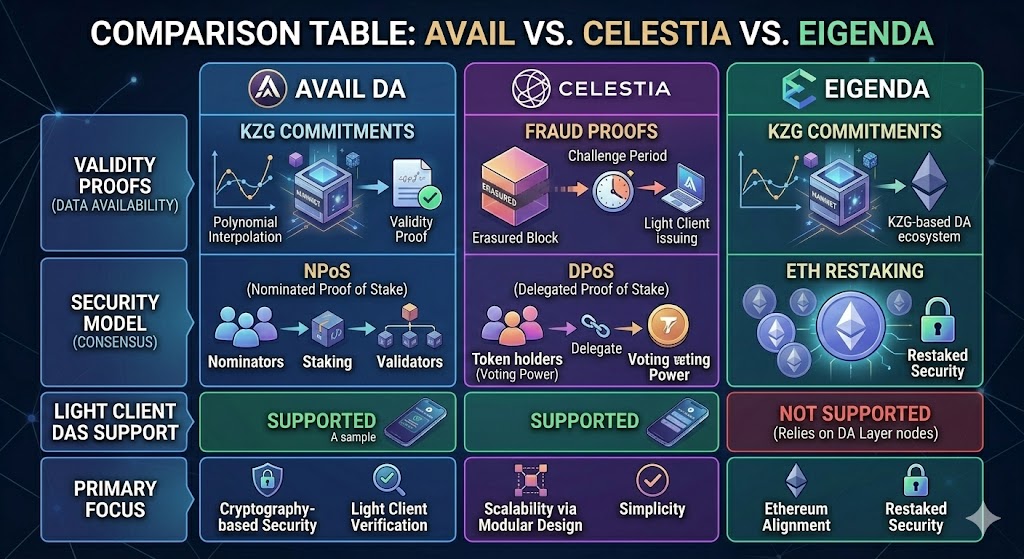
Technically speaking, Avail uses something called “KZG Commitments” to prove that data is available. Unlike “Fraud Proofs” used by some competitors, which require a waiting period to ensure no one cheated, KZG proofs are “Validity Proofs.” This means the data is proven to be correct instantly through complex math. Furthermore, this approach is “Quantum Resistant,” meaning it is designed to be secure even against future computers. Consequently, Avail is not just a solution for today, but a robust architecture built for the decades to come.
Comparing Avail (AVAIL) with Celestia and EigenDA
In the modular space, Avail has two main competitors: Celestia and EigenDA. While all three aim to solve the data availability problem, they take very different approaches. Understanding these differences is crucial for any investor or developer trying to decide which ecosystem to support. While Celestia was the first to market, Avail has introduced several technical improvements that many believe give it a significant edge in the long-term race for dominance.
Avail vs. Celestia: The Proof Battle
The biggest difference between Avail and Celestia lies in their proof systems. Celestia uses “Fraud Proofs,” which rely on the idea that if someone cheats, another person will report them within a certain time frame. Conversely, Avail uses “Validity Proofs” (KZG), which provide mathematical certainty that the data is correct immediately. Because of this, Avail does not require a “challenge period,” making it faster and theoretically more secure. Many experts argue that Avail’s math-based approach is superior for high-stakes financial applications.
Avail vs. EigenDA: Security Models
EigenDA is another competitor that lives as a layer on top of Ethereum, using Ethereum’s validators. While this sounds good, it means EigenDA is forever tied to Ethereum’s limitations and congestion. On the other hand, Avail is its own sovereign blockchain, giving it more flexibility to innovate and serve multiple chains. Furthermore, with Avail Fusion, the network can still borrow security from Ethereum, giving it the best of both worlds: the independence of a standalone chain and the security of the world’s largest smart contract network.
Why Avail is Winning the Narrative
While being “first” is an advantage for Celestia, being “better” is the goal for Avail. By the time we reached 2026, the market started to value technical efficiency over marketing hype. Avail’s ability to provide instant verification and a unified cross-chain layer through Nexus has made it the preferred choice for new “App-Chains.” In addition, the developer experience on Avail is often cited as being more streamlined. Consequently, we are seeing a steady migration of projects moving their data needs to the Avail ecosystem.
Tokenomics and the Role of the AVAIL Token
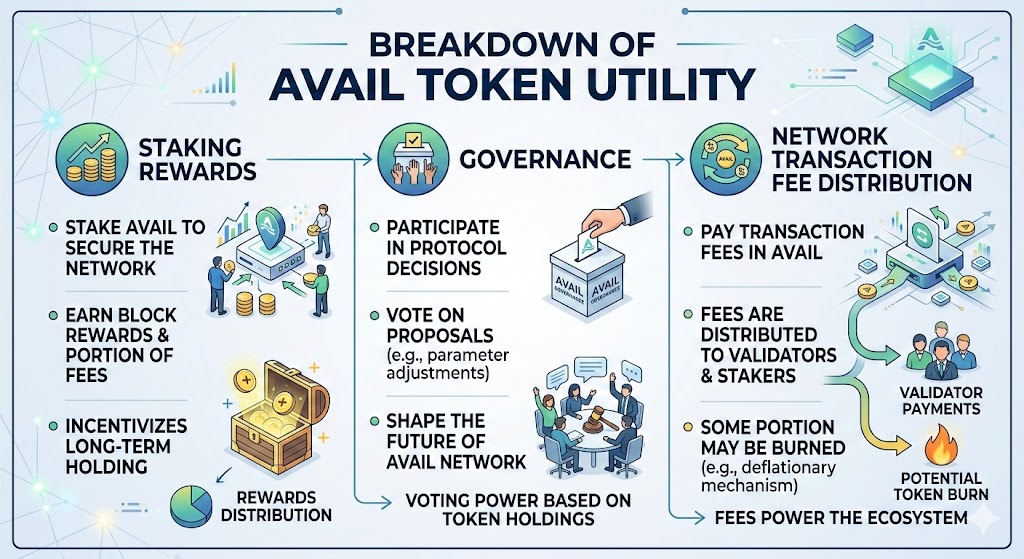
The AVAIL token is the heartbeat of the entire network, serving several vital functions that keep the ecosystem running smoothly. Unlike some tokens that have no real utility, the AVAIL token is deeply integrated into the protocol’s operations. It is used for paying transaction fees, securing the network through staking, and participating in the governance of the project. Understanding the tokenomics is essential for anyone considering adding AVAIL to their digital asset portfolio in 2026.
Utility and Transaction Fees
First and foremost, the AVAIL token is used to pay for “blobspace,” which is the space where data is stored on the blockchain. Whenever a rollup or an application wants to post data to Avail, they must pay a small fee in AVAIL tokens. As more and more applications join the ecosystem, the demand for these tokens naturally increases. Moreover, because the fees are kept very low, it encourages a high volume of transactions, creating a sustainable economic model that benefits both the users and the token holders.
Staking and Network Security
To ensure the network remains decentralized and secure, Avail uses a Nominated Proof-of-Stake (NPoS) mechanism. Token holders can stake their AVAIL tokens to support honest validators and, in return, earn staking rewards. This process not only secures the blockchain but also allows long-term holders to grow their bags over time. Furthermore, the staking system is designed to be inclusive, allowing even small holders to participate through “Nomination Pools,” ensuring that the power remains in the hands of the community.
Governance and Future Decisions
Holding AVAIL tokens also gives you a seat at the table when it comes to the future of the project. The Avail DAO (Decentralized Autonomous Organization) allows token holders to vote on important proposals, such as software upgrades or changes to the fee structure. This ensures that the project evolves in a way that reflects the needs of its users. Consequently, the token is not just a financial asset; it is a tool for participation, giving the community the power to shape the future of modular infrastructure.
Latest Developments and Ecosystem Growth in 2026
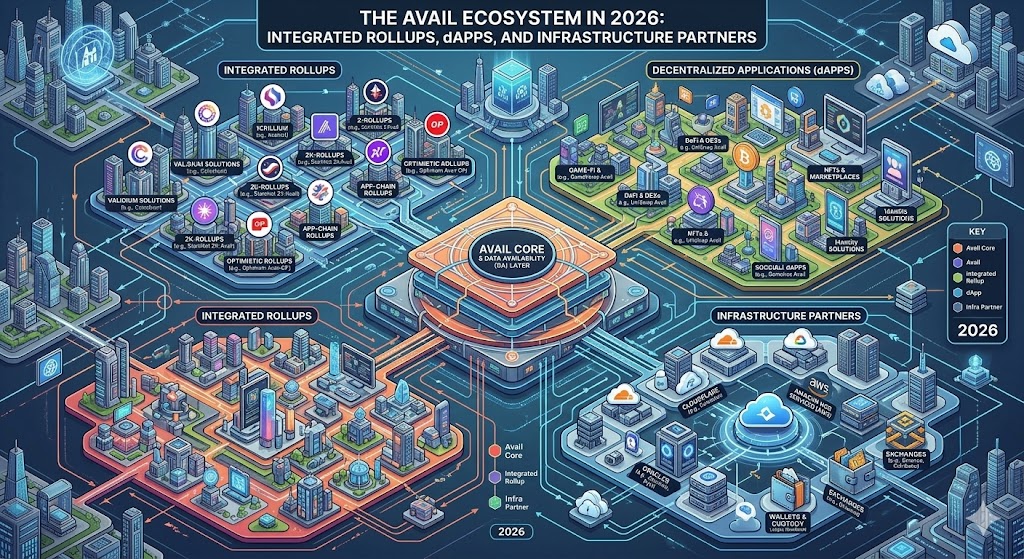
As of early 2026, Avail has transitioned from a promising startup to a dominant infrastructure powerhouse. The ecosystem has seen explosive growth, with hundreds of rollups and decentralized applications (dApps) integrating the Avail DA layer. This period has been marked by major partnerships with global tech firms and the successful launch of the “Avail Nexus” mainnet, which has finally solved the problem of fragmented liquidity across the modular world.
The Success of the Mainnet Launch
The transition to a fully functional mainnet was a turning point for the project. Following a series of highly successful testnets that saw millions of transactions, the mainnet launch was flawless, proving the stability of the KZG-based architecture. Since then, the network has maintained 100% uptime even during periods of extreme market volatility. As a result, institutional developers have gained the confidence needed to build large-scale financial tools on Avail, leading to a surge in the “Total Value Locked” (TVL) within the ecosystem.
Strategic Partnerships in 2026
In 2026, Avail announced several landmark partnerships that bridged the gap between Web2 and Web3. Major cloud providers and data centers have started running Avail nodes, further decentralizing the physical infrastructure of the network. Furthermore, Avail has integrated with major gaming studios that require high-speed, low-cost data availability for on-chain assets. These partnerships have proven that Avail is not just for “crypto natives” but is a versatile tool that can power the next generation of the internet.
The Rise of the "Avail Summer"
Much like the “DeFi Summer” of 2020, 2026 has been dubbed by many as the “Avail Summer.” This refers to the massive influx of developers who are launching “Avail-powered” chains using easy-to-use deployment kits. These tools allow anyone to launch a secure, scalable blockchain in just a few clicks. In addition, the community has grown exponentially, with global meetups and hackathons occurring regularly. Consequently, the energy surrounding the project is at an all-time high, cementing its place as a leader in the industry.

The Roadmap Ahead: Future Outlook for Investors
Looking toward the end of 2026 and beyond, the future for Avail (AVAIL) looks incredibly bright. The team’s focus has now shifted toward refining the “Fusion” layer and expanding the reach of “Nexus” to even more non-EVM chains. For investors, the long-term value proposition is clear: as the world moves toward a modular future, the demand for a fast, cheap, and secure data availability layer will only continue to grow. Avail is perfectly positioned to capture this massive market opportunity.
Expanding Beyond Ethereum
While Avail is deeply integrated with Ethereum, its ultimate goal is to become the “universal” layer for all blockchains. The upcoming phases of the roadmap include deeper integrations with the Bitcoin Lightning Network and the Solana ecosystem. By becoming a bridge between these different “silos,” Avail will play a crucial role in the future of “Interchain” communication. Moreover, this expansion will increase the utility of the AVAIL token, as it becomes a cross-chain necessity for developers across the entire crypto spectrum.
The Impact of AI and DePIN
The rise of Artificial Intelligence (AI) and Decentralized Physical Infrastructure Networks (DePIN) has created a new set of data challenges that Avail is uniquely qualified to solve. AI models require massive amounts of verifiable data, and DePIN projects need a low-cost way to store sensor logs on-chain. Avail is already being tested as the back-end for several high-profile AI-crypto projects. Consequently, this adds a whole new dimension to its potential growth, moving beyond simple finance and into the broader world of big data.
Final Thoughts on Avail's Potential
In conclusion, Avail (AVAIL) is much more than just a “hot token”; it is a fundamental piece of technology that makes the modular future possible. With its superior “Trinity” architecture, its strong leadership, and its rapidly growing ecosystem, it has all the ingredients for long-term success. While the crypto market is always unpredictable, the shift toward modularity appears to be permanent. Therefore, keeping a close eye on Avail’s progress is a smart move for anyone who believes in the transformative power of decentralized technology.
Latest Articles